
The Exhaustive Handbook to Motivation: How to Get Up and Going!
Motivation is the desire to act in service of a goal, and it decides a lot about whether you reach your goals. This free handbook from iGROW explains the four problems that block motivation, the three core human needs behind it, how to counter negative self-talk, and how to set S.M.A.R.T.E.R. goals you can stick to.
Free PDF · 21 pages · By iGROW
What you will learn
Preview the handbook
What is motivation?
In this handbook, motivation is the combination of considerations that compel someone to undertake a task. It is the desire to act in service of a goal. The handbook says it determines three things about your behaviour.
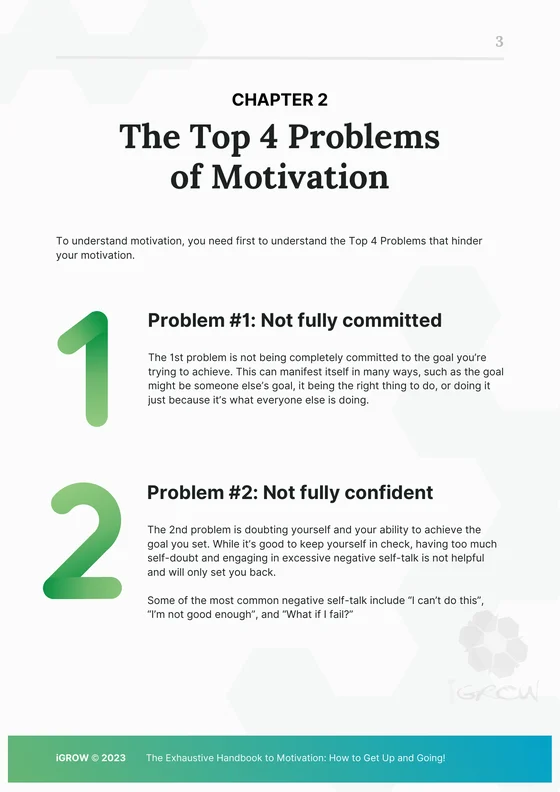
What are the top four problems of motivation?
The handbook says to understand motivation, you first need to understand what holds it back.
What are the three core human needs that drive growth?
The handbook calls them CAR for short, and adds a question or exercise for each.
Competence
You need to feel skilled in what you do and to have the resources for your goal. Ask yourself: what are three strengths that can help you achieve your goal? Write them down and remind yourself of them.
Autonomy
You need to want the goal voluntarily. Ask yourself why you want it. An exercise from the handbook: every day for 30 days, list five reasons why achieving your goal is important to you.
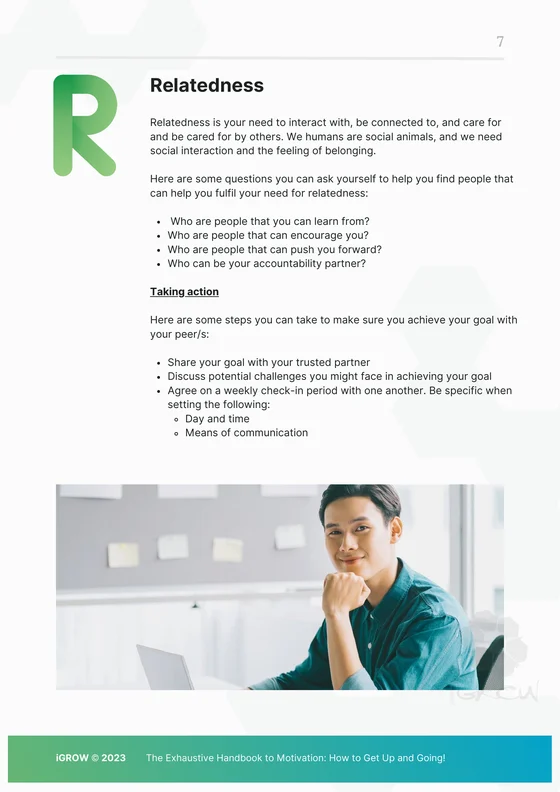
Relatedness
You need to be connected to others. Ask who can teach you, encourage you, push you forward or be your accountability partner, then share your goal with a trusted partner and agree a weekly check-in.
Free PDF, emailed to you. Just your name and email.
How does negative self-talk hold you back?
The handbook says self-talk influences your mood and behaviour: more negative self-talk means more negative emotions and lower motivation. It lists four common patterns to watch for.
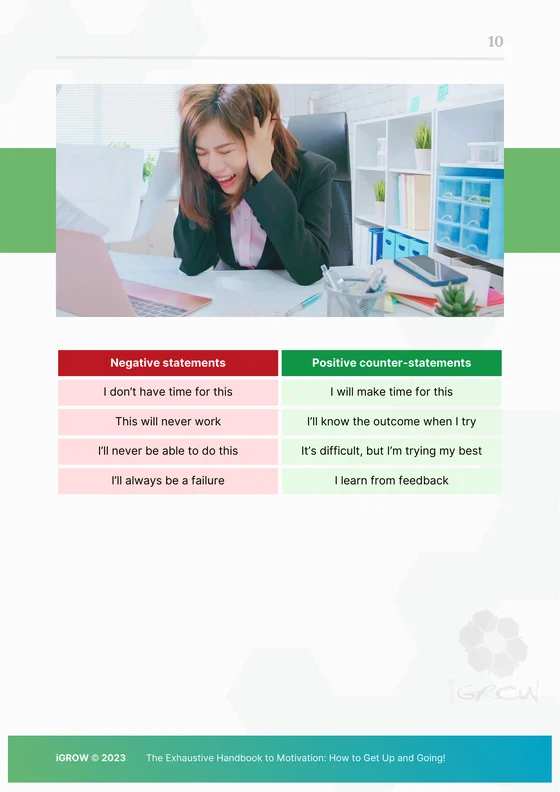
How do you write a positive counter-statement?
The handbook gives four steps, then examples of how a negative statement can be turned around.
Identify your distortions
Which of the four patterns do you lean towards?
Ask yourself: is it really true?
Should you really do things perfectly? Are the people around you really avoiding you?
Explore other possibilities
Could there be other explanations?
Write a new statement
Leave out the not's, keep it in the present tense and the first person, and have some belief in it.
What are S.M.A.R.T.E.R. goals?
A broad goal such as "I want to eat healthy" is good to have in mind, the handbook says, but too broad to act on. It offers seven letters instead.
S: Specific
Name the goal precisely rather than leaving it broad.
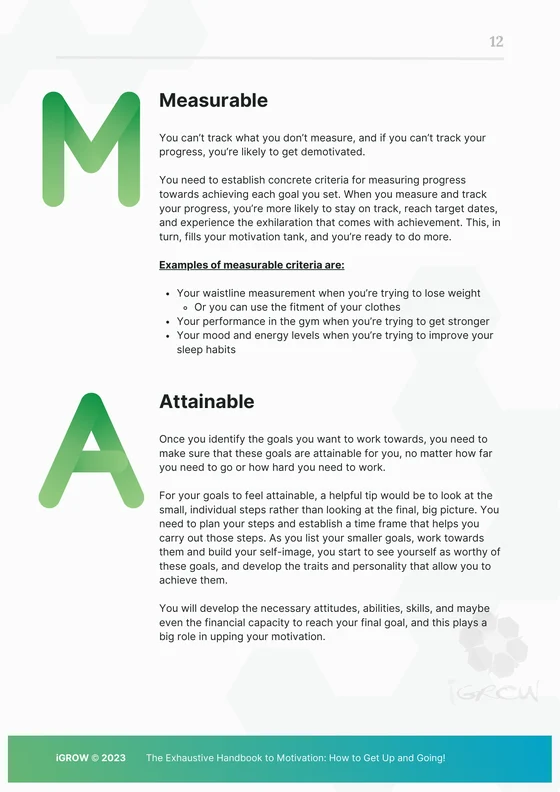
M: Measurable
Set concrete criteria so you can track progress, for example your mood and energy levels when you are improving your sleep habits.
A: Attainable
Look at small, individual steps and a time frame rather than only the big picture.
R: Realistic
Choose something you are both willing and able to work on. A hard goal can still be realistic if you believe you can achieve it.
T: Timely
Give the goal a deadline. "Someday" will not do, but "in 2 months" will.
E: Emotional connection
Know why you want the goal, and have a reason that matters to you.
R: Reward
Celebrate even small steps, without rewarding yourself so much that you undo your hard work.
Try this week: one exercise from the handbook
Pick one. Write down three strengths that can help you with a goal. Or catch one negative thought and rewrite it as a positive counter-statement in the first person and present tense. Or share your goal with a trusted partner and agree a weekly check-in.
Who publishes this handbook?
iGROW Pte Ltd is a workplace mental health consultancy in Singapore, established in 2009, with a multi-disciplinary team of professional psychologists, coaches, counsellors and consultants who work with employers on workplace mental well-being.
More free guides
All guides: iGROW resources and free guides
Also free: The Comprehensive Guide to Achieving Happiness and Gratitude
Also free: The Complete Guide to Managing Your Stress
Frequently asked questions
Is the handbook free?
Yes. It is a free 21-page PDF; enter your name and email and we will send it to you.
Who is this handbook for?
Anyone who wants to understand motivation and set goals they can stick to. It speaks to you directly, so you can use it for yourself.
What is in the handbook?
What motivation is, the top four problems of motivation, the three core human needs, how to counter negative self-talk, and S.M.A.R.T.E.R. goals.
What does S.M.A.R.T.E.R. stand for?
Specific, Measurable, Attainable, Realistic, Timely, Emotional connection and Reward.
Is this handbook a substitute for professional help?
No. If stress is affecting your daily life, speak to a doctor, counsellor or psychologist. If you are in crisis, contact emergency services or a crisis helpline.
How can my company support employee well-being?
iGROW works with employers on workplace mental well-being. Book a call to talk it through.
Get the free handbook
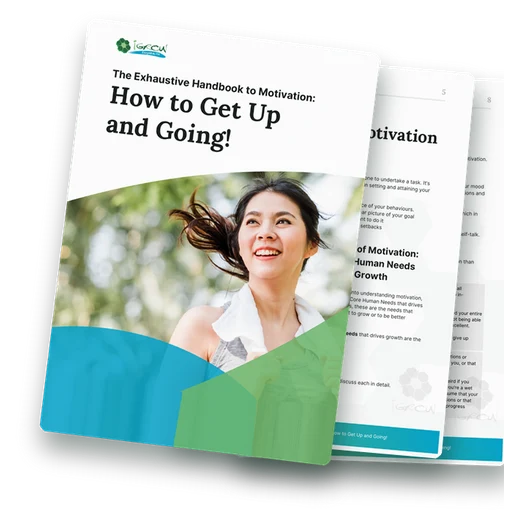
21-page PDF handbook from iGROW. Enter your details and we will email it to you.
Thank you. Check your email for the guide.Thank you. Download your guide (PDF) This link works for one hour. Submit the form again for a new one.
Free PDF. Unsubscribe any time.
Support well-being across your team
iGROW works with employers on workplace mental well-being.
Prefer to talk now? Call +65 6871 8777.
Last updated: